
Location
Payment icons
Έχεις μια καλύτερη τιμή γι αυτό το βιβλίο;
Γίνε συνεργάτης και καταχώρησε την προσφορά σου!
Γίνετε Πωλητής / Υποβολή Προσφοράς(H/B) DIO CHRYSOSTOM (VOLUME V) // DISCOURSES 61-80
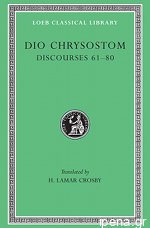
Περιγραφή
Dio Cocceianus Chrysostomus, ca. 40-ca. 120 CE, of Prusa in Bithynia, Asia Minor, inherited with his brothers large properties and debts from his generous father Pasicrates. He became a skilled rhetorician hostile to philosophers. But in the course of his travels he went to Rome in Vespasian’s reign (69-79) and was converted to Stoicism. Strongly critical of the emperor Domitian (81-96) he was about 82 banned by him from Italy and Bithynia and wandered in poverty, especially in lands north of the Aegean, as far as the Danube and the primitive Getae. In 97 he spoke publicly to Greeks assembled at Olympia, was welcomed at Rome by emperor Nerva (96-98), and returned to Prusa. Arriving again at Rome on an embassy of thanks about 98-99 he became a firm friend of emperor Trajan. In 102 he travelled to Alexandria and elsewhere. Involved in a lawsuit about plans to beautify Prusa at his own expense, he stated his case before the governor of Bithynia, Pliny the Younger, 111-112. The rest of his life is unknown. Nearly all of Dio’s extant Discourses (or Orations) reflect political concerns (the most important of them dealing with affairs in Bithynia and affording valuable details about conditions in Asia Minor) or moral questions (mostly written in later life; they contain much of his best writing). Some philosophical and historical works, including one on the Getae, are lost. What survives of his achievement as a whole makes him prominent in the revival of Greek literature in the last part of the first century and the first part of the second. The Loeb Classical Library edition of Dio Chrysostom is in five volumes. (from the publisher) + Περιεχόμενα The Sixty-First Discourse: Chryseis The Sixty-Second Discourse: On Kingship And Tyranny The Sixty-Third Discourse: On Fortune (I) The Sixty-Fourth Discourse: On Fortune (II) The Sixty-Fifth Discourse: On Fortune (III) The Sixty-Sixth Discourse: On Reputation The Sixty-Seventh Discourse: On Popular Opinion The Sixty-Eighth Discourse: On Opinion The Sixty-Ninth Discourse: On Virtue. The Seventieth Discourse: On Philosophy The Seventy-First Discourse: On The Philosopher The Seventy-Second Discourse: On Personal Appearance The Seventy-Third Discourse: On Trust The Seventy-Fourth Discourse: On Distrust The Seventy-Fifth Discourse: On Law. The Seventy-Sixth Discourse: On Custom The Seventy-Seventh/Eighth Discourse: On Envy The Seventy-Ninth Discourse: On Wealth The Eightieth Discourse: On Freedom. Encomium On Hair Fragments Letters Testimony Regarding Dio’s Life And Writings +
Χρόνος αποστολής και χρεώσεις:
Χρόνος αποστολής και χρεώσεις:
Συγνώμη, δέν μπορέσαμε να βρούμε επιλογές αποστολής για την τοποθεσία σας. Παρακαλώ επικοινωνήστε μαζί μας και θα δούμε τι μπορούμε να κάνουμε για αυτό

Λεπτομερειες
Εκδότης
ISBN
Σελίδες
Έκδοση
Τύπος
Κατάσταση
Διαστάσεις
Συνδεθείτε για να μπορέσουμε να σας ειδοποιήσουμε σχετικά με μια απάντηση