
Location
Payment icons
Έχεις μια καλύτερη τιμή γι αυτό το βιβλίο;
Γίνε συνεργάτης και καταχώρησε την προσφορά σου!
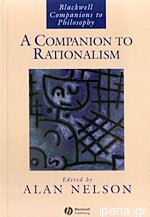
Γίνετε Πωλητής / Υποβολή Προσφοράς(H/B) A COMPANION TO RATIONALISM
Περιγραφή
What is rationalism? Philosophers have learned not to expect detailed, or even fully coherent, answers to this sweeping kind of question. There is, nevertheless, a core of rationalist thinking that can be traced through two millennia of recorded philosophical development. The rationalist insists on the distinction between appearance and reality. Reality is revealed to our rational thought, which might also be called "reason" or "intellect." Since appearance is the way reality appears to us, philosophy has two important tasks. The first is to employ rational thought to reveal the truth about the real. The second is to explain the appearances in terms of the real. Why do we naturally fasten on apparent truth instead of the real? Why must the real appear as it does when our rationality is not specially applied to it? Most rationalists want the appearances to be explained as necessary consequences of the human condition. The central example of this philosophical attitude is the explanation of sense perception. Our sensing something to be colored red is treated as depending on something that is ultimately not red - not really red - perhaps particles of light affecting our sense organs. This provides a fairly neat and iconic contrast with empiricism, the complement of rationalism. The empiricist takes sensory information as prior to, and providing data for, explanatory hypotheses. The role of these hypotheses is to classify, simplify, and interrelate the data. There is no sense in which the hypotheses are more true or real than appearances for the empiricist. The chapters in part one of this book, "The Core of Rationalism," explore these fundamental features of rationalism. "The Rationalist Impulse" explores the attitudinal differences between rationalist and empiricist philosophy. "The Rationalist Conception of Substance" tracks the development of that crucial element of rationalist reality with a particular focus on Spinoza, who made it central in his philosophy. "Rationalist Theories of Sense Perception and Mind-Body Relation" examines explanations of how appearances come to the mind through the body's sense organs and how this relates the appearances to reality so that they can be used as part of the quest for truth. Finally, the philosopher's path from a childhood immersed in the senses to a sagacious adulthood and how rationalists try to bring their readers along this path is the topic of "Rationalism and Education." [...] (From the publisher) + Περιεχόμενα List of Contributors Acknowledgments List of Abbreviations Introduction Part I - The Core of Rationalism 1. The Rationalist Impulse Alan Nelson 2. The Rationalist Conception of Substance Thomas M. Lennon 3. Rationalist Theories of Sense Perception and Mind-Body Relation Gary Hatfield 4. Rationalism and Education David Cunning Part II - The Historical Background 5. Plato's Rationalistic Method Hugh H. Benson 6. Rationalism in Jewish Philosophy Steven Nadler 7. Early Modern Critiques of Rationalist Psychology Antonia LoLordo 8. Rationalism and Method Matthew J. Kisner 9. Cartesian Imaginations: The Method and Passions of Imagining Dennis L. Sepper Part III - The Heyday of Rationalism 10. Descartes' Rationalist Epistemology Lex Newman 11. Rationalism and Representation Kurt Smith 12. The Role of the Imagination in Rationalist Philosophies of Mathematics Lawrence Nolan 13. Idealism and Cartesian Motion Alice Sowaal 14. Leibniz on Shape and the Cartesian Conception of Body Timothy Crockett 15. Leibniz on Modality, Cognition, and Expression Alan Nelson 16. Rationalist Moral Philosophy Andrew Youpa 17. Spinoza, Leibniz, and the Rationalist Reconceptions of Imagination Dennis L. Sepper 18. Kant and the Two Dogmas of Rationalism Henry E. Allison Part IV - Rationalist Themes in Contemporary Philosophy 19. Rationalism in the Phenomenological Tradition David Woodruff Smith 20. Rationalist Elements of Twentieth-Century Analytic Philosophy Paul Livingston 21. Proust and the Rationalist Conception of the Self Alan Nelson 22. Rationalism in Science David Stump 23. Rational Decision Making: Descriptive, Prescriptive, or Explanatory? Jonathan Michael Kaplan 24. What is a Feminist to do with Rational Choice? Mariam Thalos 25. Rationalism in the Philosophy of Donald Davidson Richard N. Manning Index +
Χρόνος αποστολής και χρεώσεις:
Χρόνος αποστολής και χρεώσεις:
Συγνώμη, δέν μπορέσαμε να βρούμε επιλογές αποστολής για την τοποθεσία σας. Παρακαλώ επικοινωνήστε μαζί μας και θα δούμε τι μπορούμε να κάνουμε για αυτό

Λεπτομερειες
Εκδότης
ISBN
Σελίδες
Έκδοση
Τύπος
Κατάσταση
Διαστάσεις
Συνδεθείτε για να μπορέσουμε να σας ειδοποιήσουμε σχετικά με μια απάντηση