Location
Payment icons
Έχεις μια καλύτερη τιμή γι αυτό το βιβλίο;
Γίνε συνεργάτης και καταχώρησε την προσφορά σου!
Γίνετε Πωλητής / Υποβολή Προσφοράς(H/B) ATHENS, STILL REMAINS
Περιγραφή
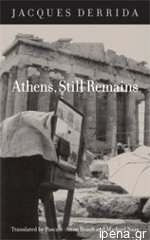
Athens, Still Remains is an extended commentary on a series of photographs of contemporary Athens by the French photographer Jean-Francois Bonhomme. But in Derridas hands commentary always has a way of unfolding or, better, developing in several unexpected and mutually illuminating directions. First published in French and Greek in 1996, Athens, Still Remains is Derrida's most sustained analysis of the photographic medium in relationship to the history of philosophy and his most personal reflection on that medium. At once photographic analysis, philosophical essay, and autobiographical narrative, Athens, Still Remains presents an original theory of photography and throws a fascinating light on Derrida's life and work. The book begins with a sort of verbal snapshot or aphorism that haunts the entire book: we owe ourselves to death. Reading this phrase through Bonhomme's photographs of both the ruins of ancient Athens and contemporary scenes of a still-living Athens that is also on its way to ruin and death, Derrida interrogates a philosophical tradition that runs from Socrates to Heidegger in which the human and especially the philosopher is thought to owe himself to death, to a certain thought of death or comportment with regard to death. Combining philosophical speculations on mourning and death, event and repetition, and time and difference with incisive commentary on Bonhomme's photographs and a narrative of Derrida's 1995 trip to Greece, Athens, Still Remains is one of Derrida's most accessible, personal, and moving works without being, for all that, any less philosophical. As Derrida reminds us, the word photography an eminently Greek word means the writing of light, and it brings together today into a single frame contemporary questions about the work of art in the age of mechanical reproduction and much older questions about the relationship between light, revelation, and truth in other words, an entire philosophical tradition that first came to light in the shadow of the Acropolis. (From the publisher) + Περιεχόμενα List of Illustrations Translators' Note Athens, Still Remains Notes +
Χρόνος αποστολής και χρεώσεις:
Χρόνος αποστολής και χρεώσεις:
Συγνώμη, δέν μπορέσαμε να βρούμε επιλογές αποστολής για την τοποθεσία σας. Παρακαλώ επικοινωνήστε μαζί μας και θα δούμε τι μπορούμε να κάνουμε για αυτό

Λεπτομερειες
Εκδότης
ISBN
Σελίδες
Έκδοση
Τύπος
Κατάσταση
Διαστάσεις
Συνδεθείτε για να μπορέσουμε να σας ειδοποιήσουμε σχετικά με μια απάντηση
Συγγραφέας: DERRIDA JACQUES