
Location
Payment icons
Έχεις μια καλύτερη τιμή γι αυτό το βιβλίο;
Γίνε συνεργάτης και καταχώρησε την προσφορά σου!
Γίνετε Πωλητής / Υποβολή Προσφοράς(H/B) DIALECTICAL DISPUTATIONS (VOLUME 2) // BOOKS II-III
Περιγραφή
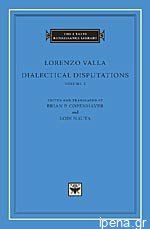
Lorenzo Valla (1407-1457) ranks among the greatest scholars and thinkers of the Renaissance. He secured lasting fame for his brilliant critical skills, most famously in his exposure of the "Donation of Constantine," the forged document upon which the papacy based claims to political power. Lesser known in the English-speaking world is Valla's work in the philosophy of language-the basis of his reputation as the greatest philosopher of the humanist movement. Dialectical Disputations, translated here for the first time into any modern language, is his principal contribution to the philosophy of language and logic. With this savage attack on the scholastic tradition of Aristotelian logic, Valla aimed to supersede it with a new logic based on the actual historical usage of classical Latin and on a commonsense approach to semantics and argument. Valla provides a logic that could be used by lawyers, preachers, statesmen, and others who needed to succeed in public debate-one that was stylistically correct and rhetorically elegant, and thus could dispense with the technical language of the scholastics, a "tribe of Peripatetics, perverters of natural meanings." Valla's reformed dialectic became a milestone in the development of humanist logic and contains startling anticipations of modern theories of semantics and language. Volume 2 contains Books II-III, in which Valla refutes Aristotle's logical works on propositions, topics, and the syllogistic. (From the publisher) + Περιεχόμενα Dialectical Disputations Book II Proem 1. What constitutes a sentence? 2. What is denominative, equivocal and univocal? 3. What kinds of sentence are there and how many? 4. On converting a sentence 5. How many signs are there and how do they differ? 6. On the effect of negating with a universal sign 7. On composite negation adjoined to a sign 8. On the difference between particular and singular signs when they take a negation 9. On the difference between composites with 'non-' or 'not-' and those with 'in-' or 'un-' for 'not-' 10. How many signs are particular and how many singular? 11. On the stupidity of those who use negation incorrectly, and on the most acceptable use of negation 12. That being unjust is no different than being not just, and likewise in similar cases 13. On the opposition of sentences 14. On contraries 15. On subcontraries 16. On contradictories 17. On subalternates 18. That opposition is not in four parts 19. That sentences are not 'modal,' what every proof aims at, and through what 20. Transition to places of arguments, taken from Quintilian 21. On technical proof 22. On signs 23. On arguments Book III Proem 1. The origin of 'dialectic' and 'logic,' what a syllogism is, what its components are, and also what a proposition is 2. On the order of the syllogism's parts 3. On the four moods of the first figure 4. Sometimes a sign is applied to the predicate, and sometimes there is no sign in the whole syllogism. 5. On the syllogism as wholly particular or singular 6. Syllogisms by whole and part 7. On the last five moods of the first figure, which must all be rejected 8. On the same number of moods in the second figure as in the first, and that the first can be converted into the second 9. The third figure must be completely disallowed. 10. On the hypothetical syllogism 11. Certain words make a syllogism complex, with several parts. 12. On heaping 13. On the dilemma and antistrophe or reversal 14. That special consideration is to be given to the weight of words 15. Teachings on examples from Quintilian 16. On induction 17. On the enthymeme Summation Appendix I: Dialectical Disputation 1.13 γ: What Is God? Appendix II: Valla's Letter to Giovanni Serra, with Selections from His Defense Against the Inquisition of Naples Appendix III: Dialectic, Propositions, and the Square of Opposition Appendix IV: Some Features of Traditional Syllogistic and Place Logic Note on the Text Notes to the Text Abbreviations Notes to the Translation Bibliography Index +
Χρόνος αποστολής και χρεώσεις:
Χρόνος αποστολής και χρεώσεις:
Συγνώμη, δέν μπορέσαμε να βρούμε επιλογές αποστολής για την τοποθεσία σας. Παρακαλώ επικοινωνήστε μαζί μας και θα δούμε τι μπορούμε να κάνουμε για αυτό

Λεπτομερειες
Εκδότης
ISBN
Σελίδες
Έκδοση
Τύπος
Κατάσταση
Διαστάσεις
Συνδεθείτε για να μπορέσουμε να σας ειδοποιήσουμε σχετικά με μια απάντηση