

san
Αυτές τις γιορτές, ο Αη-Βασίλης
φέρνει περισσότερα και...καλύτερα βιβλία
για όλους!
Location
Payment icons
Έχεις μια καλύτερη τιμή γι αυτό το βιβλίο;
Γίνε συνεργάτης και καταχώρησε την προσφορά σου!
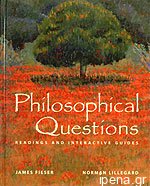
Γίνετε Πωλητής / Υποβολή Προσφοράς(H/B) PHILOSOPHICAL QUESTIONS // READINGS AND INTERACTIVE GUIDES
Περιγραφή
In Philosophical Questions: Readings and Interactive Guides, James Fieser and Norman Lillegard make classic and contemporary, philosophical writings genuinely accessible to students by incorporating numerous pedagogical aids throughout the book. Presenting the readings in manageable segments, they provide commentaries that elucidate difficult passages, explain archaic or technical terminology, and expand upon allusions to unfamiliar literature and arguments. In addition, "First Reactions" discussion questions, study questions, logic boxes, and chapter summaries require students to delve more deeply into important issues and to reconstruct arguments in their own words. Some study questions test for minimal comprehension, while others are designed to provoke analysis and independent philosophical reflection. This extensive pedagogical support enables students to more easily comprehend and engage with challenging material by establishing an interactive dialogue with the philosophers. (From the publisher) + Περιεχόμενα 1. INTRODUCING THE BOOK A. Philosophical Questions and Wonder B. Features of this Book C. A Little Logic 2. THE PHILOSOPHY OF RELIGION A. Challenges to Religious Belief 1: David Hume: The Irrationality of Believing in Miracles 2: Karl Marx: Religion as the Opium of the Masses 3: Friedrich Nietzsche: The Death of God B. The Problem of Evil C. Mysticism and Religious Experience 1: Hindu Mysticism D. The Ontological Argument for God's Existnece E. The Cosmological Argument for God's Existence F. The Design Argument for God's Existence G. Faith and Rationality 3. HUMAN NATURE AND THE SELF A. Determinism Versus Free Will B. Identity and Survival C. The Self as Active Being D. The Self Connected with a Larger Reality 4. SOULS, MINDS, BODIES, AND MACHINES A. Ancient Western Views on Body, Soul, and Mind B. Classic Hindu Views on Soul, Self, and God C. Modern Views on Mind and Body D. Twentieth-Century Views on Mind and Body E. Intentionality F. Minds and Machines 5. EPISTEMOLOGY A. Skepticism and Certainty B. Sources of Knowledge: Rationalism and Empiricism C. A Priori Knowledge D. Foundationalism and Coherence E. Problems with Justified Belief F. The Social Construction of Knowledge 6. ETHICS A. Are Moral Values Objective? B. Can Human Conduct Be Selfless? C. Reason and Moral Judgments D. Gender and Morality E. Virtues F. Duties G. Pleasure and Consequences 7. POLITICAL PHILOSOPHY A. Anarchism B. Sources of Political Authority C. Liberalism and Communitarianism D. Virtuous Leadership E. Limits of Political Coercion F. Civil Obedience, Disobedience, and Revolution +
Χρόνος αποστολής και χρεώσεις:
Χρόνος αποστολής και χρεώσεις:
Συγνώμη, δέν μπορέσαμε να βρούμε επιλογές αποστολής για την τοποθεσία σας. Παρακαλώ επικοινωνήστε μαζί μας και θα δούμε τι μπορούμε να κάνουμε για αυτό

Λεπτομερειες
Εκδότης
ISBN
Σελίδες
Έκδοση
Τύπος
Κατάσταση
Διαστάσεις
Συνδεθείτε για να μπορέσουμε να σας ειδοποιήσουμε σχετικά με μια απάντηση