

san
Αυτές τις γιορτές, ο Αη-Βασίλης
φέρνει περισσότερα και...καλύτερα βιβλία
για όλους!
Location
Payment icons
Έχεις μια καλύτερη τιμή γι αυτό το βιβλίο;
Γίνε συνεργάτης και καταχώρησε την προσφορά σου!
Γίνετε Πωλητής / Υποβολή Προσφοράς(P/B) SECOND MANIFESTO FOR PHILOSOPHY
Περιγραφή
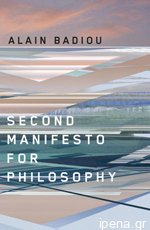
Twenty years ago, Alain Badiou's first Manifesto for Philosophy rose up against the all-pervasive proclamation of the "end" of philosophy. In lieu of this problematic of the end, he put forward the watchword: "one more step". The situation has considerably changed since then. Philosophy was threatened with obliteration at the time, whereas today it finds itself under threat for the diametrically opposed reason: it is endowed with an excessive, artificial existence. "Philosophy" is everywhere. It serves as a trademark for various media pundits. It livens up cafe's and health clubs. It has its magazines and its gurus. It is universally called upon, by everything from banks to major state commissions, to pronounce on ethics, law and duty. In essence, "philosophy" has now come to stand for nothing other than its most ancient enemy: conservative ethics. Badiou's second manifesto therefore seeks to demoralize philosophy and to separate it from all those "philosophies" that are as servile as they are ubiquitous. It demonstrates the power of certain eternal truths to illuminate action and, as such, to transport philosophy far beyond the figure of "the human" and its "rights". There, well beyond all moralism, in the clear expanse of the idea, life becomes something radically other than survival. (From the publisher) + Περιεχόμενα Editor's Preface Alain Badiou Thinking the Event Thesis 1: Thought is the proper medium of the universal Thesis 2: Every universal is singular, or is a singularity Thesis 3: Every universal originates in an event, and the event is intransitive to the particularity of the situation Thesis 4: A universal initially presents itself as a decision about an undecidable Thesis 5: The universal has an implicative form Thesis 6: The universal is univocal Thesis 7: Every universal singularity remains incompletable or open Thesis 8: Universality is nothing other than the faithful construction of an infinite generic multiple Slavoj Zizek 'Philosophy is not a dialogue' Discussion +
Χρόνος αποστολής και χρεώσεις:
Χρόνος αποστολής και χρεώσεις:
Συγνώμη, δέν μπορέσαμε να βρούμε επιλογές αποστολής για την τοποθεσία σας. Παρακαλώ επικοινωνήστε μαζί μας και θα δούμε τι μπορούμε να κάνουμε για αυτό

Λεπτομερειες
Εκδότης
ISBN
Σελίδες
Έκδοση
Τύπος
Κατάσταση
Διαστάσεις
Συνδεθείτε για να μπορέσουμε να σας ειδοποιήσουμε σχετικά με μια απάντηση
Συγγραφέας: BADIOU ALAIN
