Location
Payment icons
Έχεις μια καλύτερη τιμή γι αυτό το βιβλίο;
Γίνε συνεργάτης και καταχώρησε την προσφορά σου!
Γίνετε Πωλητής / Υποβολή Προσφοράς(P/B) SOUND, SENSE, AND RHYTHM // LISTENING TO GREEK AND LATIN POETRY
Περιγραφή
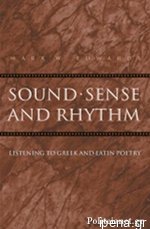
This book concerns the way we read--or rather, imagine we are listening to--ancient Greek and Latin poetry. Through clear and penetrating analysis Mark Edwards shows how an understanding of the effects of word order and meter is vital for appreciating the meaning of classical poetry, composed for listening audiences. The first of four chapters examines Homer's emphasis of certain words by their positioning; a passage from the Iliad is analyzed, and a poem of Tennyson illustrates English parallels. The second considers Homer's techniques of disguising the break in the narrative when changing a scene's location or characters, to maintain his audience's attention. In the third we learn, partly through an English translation matching the rhythm, how Aeschylus chose and adapted meters to arouse listeners' emotions. The final chapter examines how Latin poets, particularly Propertius, infused their language with ambiguities and multiple meanings. An appendix examines the use of classical meters by twentieth-century American and English poets. Based on the author's Martin Classical Lectures at Oberlin College in 1998, this book will enrich the appreciation of classicists and their students for the immense possibilities of the languages they read, translate, and teach. Since the Greek and Latin quotations are translated into English, it will also be welcomed by non-classicists as an aid to understanding the enormous influence of ancient Greek and Latin poetry on modern Western literature. (From the publisher) + Περιεχόμενα Preface CHAPTER ONE: Homer I: Poetry and Speech The Older Discoveries: Frankel and Parry The New Theories. Functional Grammar and the Grammar of Speech Homeric Style in Tennyson's Morte d'Arthur Homeric Style in the Duels of Achilles CHAPTER TWO: Homer II: Scenes and Summaries The Book Divisions The Paragraph Divisions Joining Episode to Episode Continuity and Oral Poetics CHAPTER THREE: Music and Meaning in Three Songs of Aeschylus The First Choral Song (Agamemnon 104-257) The Second Choral Song (Agamemnon 367-488) The Third Choral Song (Agamemnon 681-781) The Rest of the Agamemnon, and of the Trilogy CHAPTER FOUR: Poetry in the Latin Language Latin Word Order Ambiguity in Latin Verse Propertius . AFTERWORD APPENDIX A: Tennyson's Morte d'Arthur APPENDIX B: "" Continuity in Mrs. Dalloway APPENDIX C: The Performance of Homeric Episodes APPENDIX D: Classical Meters in Modern English Verse REFERENCES INDEX +
Χρόνος αποστολής και χρεώσεις:
Χρόνος αποστολής και χρεώσεις:
Συγνώμη, δέν μπορέσαμε να βρούμε επιλογές αποστολής για την τοποθεσία σας. Παρακαλώ επικοινωνήστε μαζί μας και θα δούμε τι μπορούμε να κάνουμε για αυτό

Λεπτομερειες
Εκδότης
ISBN
Σελίδες
Έκδοση
Τύπος
Κατάσταση
Συνδεθείτε για να μπορέσουμε να σας ειδοποιήσουμε σχετικά με μια απάντηση
Συγγραφέας: EDWARDS W. MARK